Hexagonal Architecture in Rust: A Beginner’s Guide
Learn how to structure your Rust code with ports, adapters, and clean separation of concerns using practical examples.
TL;DR
- For beginners, tinkerers, hobbyists, amateurs, and early-career developers…
- Ports = Traits
- Adapters = Implementations
applicationowns the use caseapplicationborrows adapters- The caller decides which
adapterto plug in applicationis NOT a container foradapters, but a consumer ofports.applicationorchestrates the use case,portsdefine the contracts andadaptersplug concrete behavior into those contracts
All the examples are on GitHub

2005: When Hexagonal Architecture emerged and War of the Worlds hit theaters.
Table of Contents
- Introduction
- Show me the code!
ex00.rstypes organization- About ex01.rs
- Testing
application - I’m a liar
- More than one adapters on the same port
- Tea Time! Let’s take a break
- Multiple ports, multiple adapters
- Optional:
ex07.rscode review - Webliography
Introduction
Just to make sure you did’nt reach this page in order to learn how to draw an hexagon on screen with Rust… Hexagonal Architecture is a way to structure an application around its use cases rather than its technical details. In this article, we explore how the application core acts as an orchestrator, coordinating work without owning the implementation. Don’t worry about the fancy terminology: hexagons, architecture, ports, adapters, business rules. At the end of the day, this all boils down to writing traits, implementing structs, and defining a few enums.
This said… Don’t ask me why but our company wants to develop its own Orders Management System. We had a first meeting with the board: CFO, COO, CEO… They speak “business” they have their own vocabulary, rules, invariants… To tell the truth, they don’t care if they receive orders via email or by owl. They don’t care if orders are tracked in a database or on papyrus… They want to process orders as fast as possible, ship products in a matter of minutes and send the invoices within the same second.
If we must write an application for these guys one of the idea is to decouple the business from the external concerns like user interfaces, databases… What “Uncle Bob’s” call the “details” in the book Clean Architecture.

Do not misinterpret the word “business” above. We could be talking about “how to operate a nuclear plant” or “how to operate a cabaret”… In each case the business is different but a business remains a business.
One option could be to apply the Dependency Inversion Principle. You can read more about DIP on this page. However real applications are complex: they need storage, payment systems, notification services… How do we scale DIP to handle all of that?
This is the purpose of the Hexagonal Architecture which leverages what we already know about SOLID and DIP but goes one step further.
At the heart of Hexagonal Architecture are the concepts of Ports and Adapters.
- Ports are interfaces that define contracts for the communications between the business and the components.
- Adapters are implementations of these interfaces.
Note: Think of it that way: “Ciao ragazze! I’m the latest Ferrari cell phone and you know what? If you want to reload my battery, connect an external drive or a ledger, like on any car you will have to use an OBD-II port.”

This is an OBD-II connector
I know this is ridiculous… However keep in mind that, in this context, this is the phone which impose the port. As a supplier, if you want to get the “Ferrari Compatibility Label” you have no choice than to provide an OBD-II compliant connector for your wired earphones. Good luck!
As on any electronic device there are two types of Ports:
- Output Ports: aka driven ports (secondary). Describe the methods the business is ready to use to send “Stuff” outside. Here, “Stuff” may be a invoice, notifications… I say “ready to use” because I want to insist on the fact that this is the business, the core, which defines the means to be used. This is nothing else than DIP in action.
- Input Ports: aka driving ports (primary). Describe how the business is ready to receive “Stuff” from external systems. Here “Stuff” could be a messages, an order… Again, the core define the methods that external systems will have to use to trigger actions in the core. The keyword here is “will have to use”. Yes, this is 4 words but the point is that this is mandatory. If you don’t use the input port the business will not take your request/call into account.
Things to keep in mind:
- Ports = Traits (Interfaces in plain Rust)
- Adapters = Implementations (Rust
impl Xyz for Abc)
Note: Why DIP alone isn’t sufficient? DIP is a principle, it explains what we have to do but not how to organize our architecture. For example DIP doesn’t tell us where to place our abstractions (traits), nor how to organize dependencies between layers and what depends on what at the architectural level. On the other hand, the Hexagonal Architecture clearly defines what is the domain (the business logic, the center of the hexagon), what are the ports (interfaces defining how the outside world interacts with our domain) and what are the adapters (concrete implementations of ports, outside the hexagon). Keep in mind: DIP = What | Hexagon Architecture = How.
Now… The one million dollar question. Is there a way to demonstrate an Hexagonal Architecture in less than 100 lines of code?
Show me the code!
Get the Rust project from the repo. The examples are in the examples/ folder. Run the first sample with:
cargo run --example ex00
Expected output:
[Console] Order #1 confirmed! Total: 4999
Success! Order #1 processed.
I want to make sure “we learn how to walk before we try to run”. So let’s take some time to review the code of ex00.rs and understand how this works at the simplest level. Open the code. Good news, it is 85 LoC.
Lines 1-20
We left the meeting with the board and now, we know more about their vocabulary. So, we create a module named domain where we recreate the entities we heard about.
mod domain {
    use std::fmt;

    #[derive(Debug, Clone)]
    pub struct Order {
        pub id: u32,
        pub total: u32,
    }

    #[derive(Debug)]
    pub enum OrderError {
        // Failed,
    }

    impl fmt::Display for OrderError {
        fn fmt(&self, f: &mut fmt::Formatter<'_>) -> fmt::Result {
            write!(f, "{self:?}")
        }
    }
}
First we create the type Order. What is an Order? An Order is an id associated with a total. We may not agree but, if tomorrow morning we cross the CFO at the cafeteria, we can discuss with him using his vocabulary. He will not be lost and more than happy to help us. If needed we will be able to add field to the struct later.
Second, we create a type OrderError. What is an OrderError? It is not yet crystal clear but we know for sure that an error is only one kind of error at a time so we create an empty enum. Once we know more about the kind of business errors they encounter in their domain we will be able to add variants to the enum. At the end, we implement the Display trait for the OrderError.
Note:
Here, all the modules are in the same source file. In a real application each module would be in its own folder.
Lines 22-28
mod ports {
    use crate::domain::{Order, OrderError};

    pub trait OrderNotifier {
        fn process(&self, order: &Order) -> Result<(), OrderError>;
    }
}
We create a ports module. “Remember the Alamo” but remember that ports = traits. So we “just” define which methods must be available if something want to be considered as a valid OrderNotifier.
Note that the module ports depends on domain because the .process() method sends a domain::Order and return a Result<(), domain::OrderError>.
Lines 30-45
mod adapters {
    use crate::domain::{Order, OrderError};
    use crate::ports::OrderNotifier;

    pub struct ConsoleNotifier;

    impl OrderNotifier for ConsoleNotifier {
        fn process(&self, order: &Order) -> Result<(), OrderError> {
            println!(
                "[Console] Order #{} confirmed! Total: {}",
                order.id, order.total
            );
            Ok(())
        }
    }
}
We said adapters = implementations. In this module we define a ConsoleNotifier, a concrete data type. Once this is done, since we want that the objects of type ConsoleNotifier being used to process orders, we implement the OrderNotifier trait for the ConsoleNotifier. In our case this consist in defining what will happen when the .process() method will be invoked.
Note that in the module adapters we depend on domain and ports because we implement a trait defined in ports which act on objects defined in domain (Order for example)
Lines 47-74
For me, this is where the magic takes place.
mod application {
    use crate::domain::{Order, OrderError};
    use crate::ports::OrderNotifier;

    pub struct OrderService<N: OrderNotifier> {
        notifier: N,
        next_id: u32,
    }

    impl<N: OrderNotifier> OrderService<N> {
        pub fn new(notifier: N) -> Self {
            Self {
                notifier,
                next_id: 1,
            }
        }

        pub fn process_order(&mut self, total: u32) -> Result<Order, OrderError> {
            let order = Order {
                id: self.next_id,
                total,
            };
            self.next_id += 1;
            self.notifier.process(&order)?;
            Ok(order)
        }
    }
}
The code of the module application is important because this is where we define and implement a generic OrderService data type over the trait OrderNotifier. Realize that this means that any concrete type having the OrderNotifier trait can be used. Thanks to Rust, expressing this intent is almost natural.
So far, only the ConsoleNotifier data type has the trait OrderNotifier but, tomorrow, we can easily extend the application with a BellNotifier (people ring a bell when an order is received).
Once the generic OrderService is defined, then we write its implementation which consist of 2 methods: new() and .process_order(). The latter use the .process() method that any object having the OrderNotifier trait has.
Take some time to read and understand each line of the code above. At the end you must be convinced that application is the place where we describe the use case: receive an order, ring the bell, send an invoice… And we do this without knowing how this will happens. When .ring_the_bell() is invoked, does someone get up to go to the bell and use a hammer, or do they press a button on their desk or on their screen? I don’t know, and that’s not the point.
Note that in the module application we depend on domain and ports because we create an OrderService data type which depends on an OrderNotifier trait defined in ports which act on object defined in domain (Order for example)
Lines 76-86
fn main() {
    use adapters::ConsoleNotifier;
    use application::OrderService;

    let mut service = OrderService::new(ConsoleNotifier);

    match service.process_order(4999) {
        Ok(order) => println!("Success! Order #{} processed.", order.id),
        Err(e) => println!("Error: {e}"),
    }
}
Show time! All the pieces fit together. The code involved is very short. This is NOT the problem here. No, in fact my main concern is to make sure we all understand that above, the application module is NOT an executable. For obvious didactic reasons I keep all the modules in one source code, but, repeat after me, application is NOT an executable but should be considered more like a lib.
In this context main() is:
- Not part of Hexagonal Architecture
- Not part of the
applicationcore - Just a delivery mechanism
- A primary adapter
Think of it as a “client”, a proof that the architecture works. main() belongs to an adapter and does not include any business logic. From the files and folders stand point you can keep this model in mind if this helps:
my_app/
├── domain/
├── application/
├── adapters/
├── ports/
├── main.rs
Now, having all this in mind we can read the code of main(). We create a new OrderService based on the data type ConsoleNotifier which implements the trait OrderNotifier. Then we call .process_order() and print the results.
Note:
- Naming is difficult. Order, Invoice, Notifier… I realize things should/could be better. Welcome to the club! Hopefully, intellisense (F2) is our friend.
Note:
From a pragmatic point of view I would suggest to:
- Start by “fixing the vocabulary”. I mean, first, work on the
domainmodule and define the data types of the business you are modeling. Make sure everybody agree. - Then I would work on the
ports(interface, traits) - Using the ports, write the use cases in the
applicationmodule as you would describe, in plain English, what is going on during such or such use case. - Write the
adaptersmodules and the concrete implementation. - Finalize the
main()function adding the neededuse...statements - Sleep on it
- Review it with a colleague tomorrow morning.
ex00.rs types organization
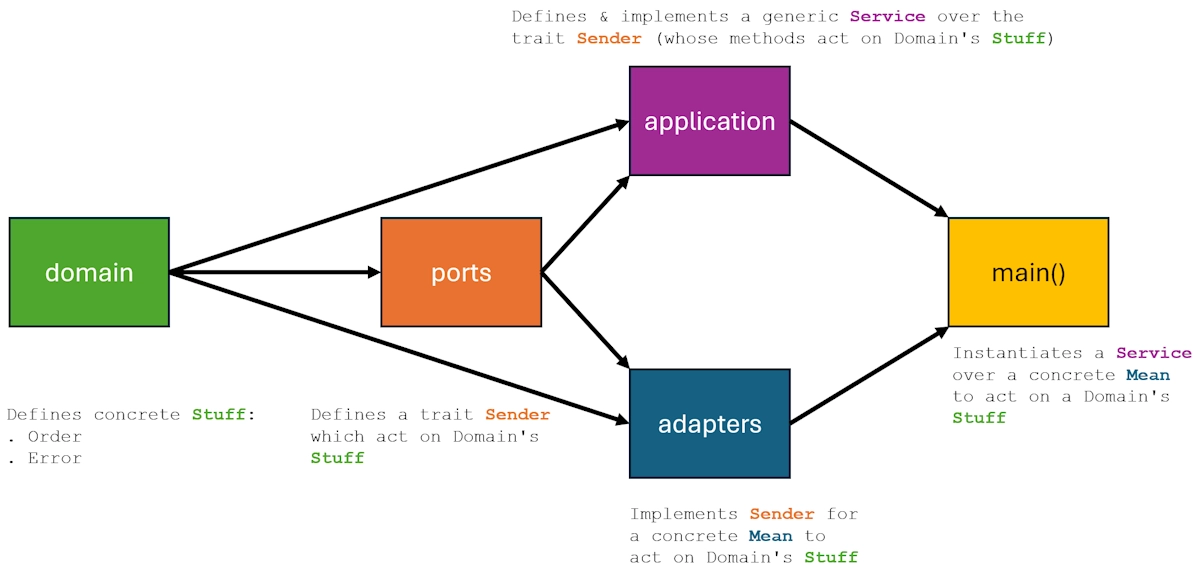
- Below I use
Senderinstead ofOrderNotifier - The arrows show the dependencies:
portsdepends ondomain,domaindepends on no one.
Visual Representation of our Hexagonal Architecture
The graph above helps to understand why, quite often, the ports are defined in the domain. Doing so simplify the graph. For example, this is the organization I use in this project.
About ex01.rs
The code is the same but the domain is slightly different. I just want to make sure we understand that business/domain can be anything.
cargo run --example ex01
Expected output:
[Megaphone] 🎪 Act #1 is ON! Silliness level: 9001
🤡 Success! Clown act #1 scheduled.
Skim over the code because, compared to ex00.rs I just renamed some variables.

Optional comment
Testing application
Again, the previous main() function was, may be, misleading. So let’s go extreme and let’s remove it completely. And you know what? Let’s remove also the adapter that main() was using. Remember, adapters are replaceable and owned by the caller, not by the application.
Ok… But what can we do next? Easy, let’s write some test. Try this:
cargo test --example ex02
Expected output:
running 1 test
test tests::process_order_successfully ... ok

test result: ok. 1 passed; 0 failed; 0 ignored; 0 measured; 0 filtered out; finished in 0.00s
Obviously, since we removed main() we cannot cargo run --example ex02 but this simple experimentation is an attempt to demonstrate some of the key ideas are of the Hexagonal Architecture:
- The
domainandapplicationdo not depend on infrastructure - The
applicationis driven byports, NOT by a runtime entry point (main()) - We can exercise the system without any real
adaptersand this is really smart.
So let’s keep in mind that by replacing main() with one focused test we prove ourselves that:
- The
applicationcore is usable in isolation - Adapters are just plug-ins
- The system is testable by construction
Let’s see the making of and let’s open ex02.rs
Lines 62-85
The rest of the code is untouched so we can focus our attention to the test module.
#[cfg(test)]
mod tests {
    use crate::application::OrderService;
    use crate::domain::{Order, OrderError};
    use crate::ports::OrderNotifier;

    struct TestNotifier;

    impl OrderNotifier for TestNotifier {
        fn process(&self, _order: &Order) -> Result<(), OrderError> {
            Ok(())
        }
    }

    #[test]
    fn process_order_successfully() {
        let mut service = OrderService::new(TestNotifier);

        let order = service.process_order(4999).unwrap();

        assert_eq!(order.id, 1);
        assert_eq!(order.total, 4999);
    }
}
If you remember, in ex00.rs, main() was using a ConsoleNotifier which was defined and implemented in the adapters module (lines 30-45 of ex00.rs). Here, we no longer have the adapters module.
So, first thing first, at the top of the tests module we start by creating our own TestNotifier and we implement OrderNotifier for it. In other words we are creating our test adapter.
When this is done, we can write the test process_order_successfully() test function, where, as before in the main() function, we create a new OrderService based on the data type TestNotifier which implements the trait OrderNotifier. Then we call .process_order() and check the results.
By now, it should be clear that in an Hexagonal Architecture the application never knows whether it’s being used by a CLI, a web server, a test… The caller decides which adapter to plug in.
Finally, let’s realize that tests are not special. They are just another driving adapter.
I’m a liar
In order to keep ex00.rs as simple as possible I used a trick and I’m not very proud of. So let’s look at it in detail because, as you know… The evil is in the details.

To make a long story short, in ex00.rs the module application was owning a Notifier. Open ex00.rs, search the application module. We have:
pub struct OrderService<N: OrderNotifier> {
    notifier: N,
    next_id: u32,
}
This is NOT wrong. This a choice of design with some advantages:
- Simple to understand
- No lifetimes
- No references
- Works perfectly if:
- there is only one adapter
- the adapter has no observable state
- we never need to access the adapter again (because it is given)
For a first contact with Hexagonal Architecture ideas, it was totally fine. However, this becomes a problem as soon as we want to experiment with more advanced, but typical, Hexagonal scenarios:
- Multiples adapters on the same port
- An adapter with internal state
- Observing what an adapter did
- Reusing the same adapter instance elsewhere
With the original design, the adapter is hidden inside the application, the outside world cannot see it and accessing it would require:
- exposing internal fields (bad)
- or even worse, adding getters just for adapters
- or redesigning later anyway
So now that we understand the basic implementation (ex00.rs) let’s slightly refine the initial design without changing the behavior. No worries, we will go one step at a time.
Step 1: Most important change. In the application module, we start with:
pub struct OrderService<N: OrderNotifier> {
    notifier: N,
    next_id: u32,
}
and we end with:
pub struct OrderService<'a, N: OrderNotifier> {
    notifier: &'a N,
    next_id: u32,
}
Now the application has a reference to the Notifier (more accurately, it has a reference to a variable which possess the trait OrderNotifier)
The lifetime specifier 'a is mandatory. It’s a nudge for the compiler and a promise from us that the referenced notifier will live at least as long as the OrderService that uses it.
Then the implementation has to be modified. We go from:
impl<N: OrderNotifier> OrderService<N> {
    pub fn new(notifier: N) -> Self {
        Self {
            notifier,
            next_id: 1,
        }
    }
    // Same as before
}
To
impl<'a, N: OrderNotifier> OrderService<'a, N> {
    pub fn new(notifier: &'a N) -> Self {
        Self {
            notifier,
            next_id: 1,
        }
    }
    // Same as before
}
The last change occurs in main() where we transition from:
fn main() {
    // Same as before
    let mut service = OrderService::new(ConsoleNotifier);
    // Same as before
}
To
fn main() {
// Same as before
let notifier = ConsoleNotifier;
let mut service = OrderService::new(¬ifier);
// Same as before
}
Do you see the reference used as an argument?. Cool, but does this work?
cargo run --example ex03
Expected output:
[Console] Order #1 confirmed! Total: 4999
Success! Order #1 processed.
Let’s keep in mind that the application is NOT a container for adapters. It is a consumer of ports.
More than one adapters on the same port
In a typical hexagonal architecture
- it is OK to have more than one adapter to the same port.
- adding a new adapter to an existing port does not require any changes to the
domain,ports, orapplicationmodules.
In VSCode if you compare ex03.rs and ex04.rs you should realize that:
- the
domainmodule remains untouched portsis not modifiedapplicationis not modified either
You should see something like this:
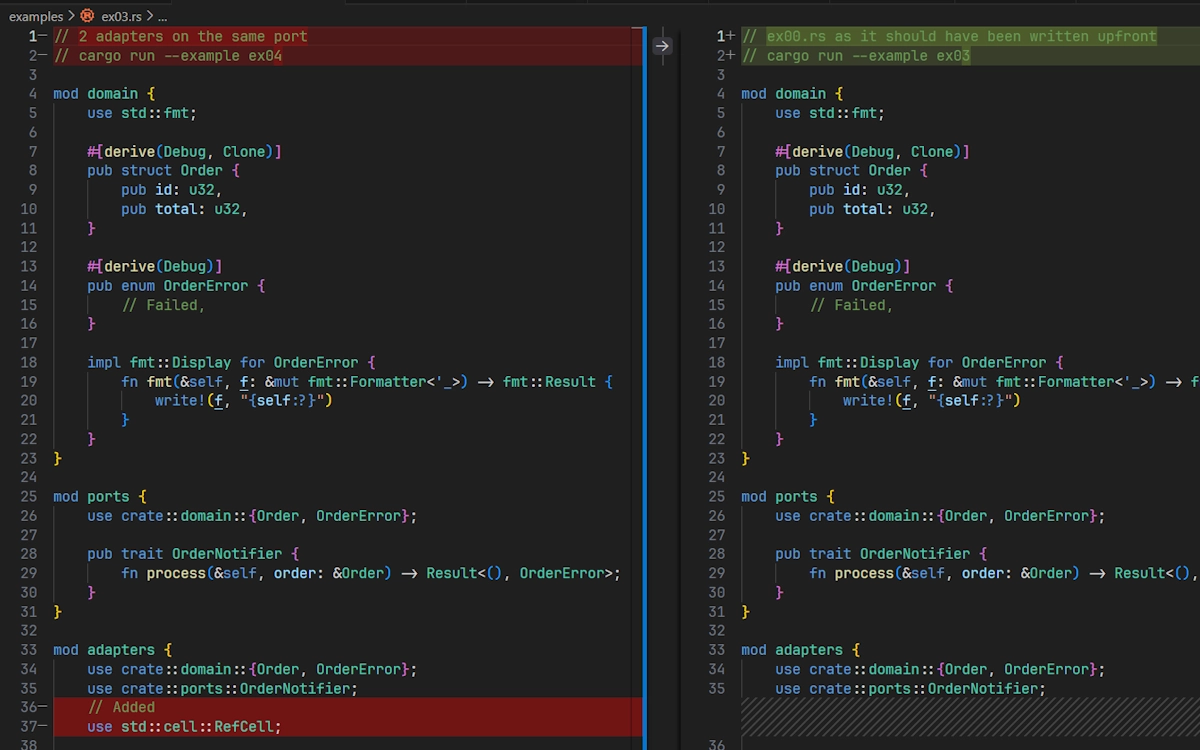
domain, ports and application modules remain untouched when adding a new adapter. Obviously we must add a new adapter in the adapters module. This is done by adding use std::cell::RefCell; at the top of the module plus the lines below:
    pub struct InMemoryNotifier {
        messages: RefCell<Vec<String>>,
    }

    impl InMemoryNotifier {
        pub fn new() -> Self {
            Self {
                messages: RefCell::new(Vec::new()),
            }
        }

        pub fn messages(&self) -> Vec<String> {
            self.messages.borrow().clone()
        }
    }

    impl OrderNotifier for InMemoryNotifier {
        fn process(&self, order: &Order) -> Result<(), OrderError> {
            self.messages.borrow_mut().push(format!(
                "Order #{} stored, total = {}",
                order.id, order.total
            ));
            Ok(())
        }
    }
The second and last modification occurs in the main() function. We first bring the brand new InMemoryNotifier into the local scope and then we use it as shown below:
let memory_notifier = InMemoryNotifier::new();
let mut memory_service = OrderService::new(&memory_notifier);
memory_service.process_order(42).unwrap();

for message in memory_notifier.messages() {
    println!("[Memory] {message}");
}
That’s all. But does it works? Let’s test how the 2 adapters work on the same port.
cargo run --example ex04
Expected output:
[Console] Order #1 confirmed! Total: 4999
[Memory] Order #1 stored, total = 42
Tea Time! Let’s take a break

Let’s step back for a while in order to internalize the shape of the Hexagonal Architecture, forget the details and avoid to be distracted by the behaviors. At this point I want to make sure we remember that:
domaincontains the entities of the business- ports = traits, they are stable contracts
- adapters = implementation, they are placeholders
applicationborrows adapters- tests show how the system is driven
Now let’s read the “template” below:
mod domain {
    #[derive(Debug, Clone, PartialEq)]
    pub struct Stuff {
        pub value: u32,
    }

    #[derive(Debug)]
    pub enum StuffError {}
}

mod ports {
    use crate::domain::{Stuff, StuffError};

    pub trait StuffHandler {
        fn handle(&self, stuff: &Stuff) -> Result<(), StuffError>;
    }
}

mod adapters {
    use crate::domain::{Stuff, StuffError};
    use crate::ports::StuffHandler;

    pub struct MyAdapter;

    impl StuffHandler for MyAdapter {
        fn handle(&self, _stuff: &Stuff) -> Result<(), StuffError> {
            todo!("Adapter implementation goes here");
        }
    }
}

mod application {
    use crate::domain::{Stuff, StuffError};
    use crate::ports::StuffHandler;

    pub struct StuffService<'a, H: StuffHandler> {
        handler: &'a H,
    }

    impl<'a, H: StuffHandler> StuffService<'a, H> {
        pub fn new(handler: &'a H) -> Self {
            Self { handler }
        }

        pub fn process(&self, value: u32) -> Result<Stuff, StuffError> {
            let stuff = Stuff { value };
            self.handler.handle(&stuff)?;
            Ok(stuff)
        }
    }
}

#[cfg(test)]
mod tests {
    use crate::application::StuffService;
    use crate::domain::{Stuff, StuffError};
    use crate::ports::StuffHandler;

    struct TestHandler;

    impl StuffHandler for TestHandler {
        fn handle(&self, _stuff: &Stuff) -> Result<(), StuffError> {
            Ok(())
        }
    }

    #[test]
    fn process_stuff_successfully() {
        let service = StuffService::new(&TestHandler);

        let stuff = service.process(42).unwrap();

        assert_eq!(stuff.value, 42);
    }
}
Does this code tells you a story? Do you hear it? For me, again, the key is in the application module when we define (then implement) a generic StuffService data type over the trait StuffHandle.
pub struct StuffService<'a, H: StuffHandler> {
    handler: &'a H,
}
The template could be shorter without the test module but I hate code fragment that doesn’t work. Here you can use the template. You can either copy and past it in Rust Playground or try this:
cargo test --example ex05
Expected output:
running 1 test
test tests::process_stuff_successfully ... ok

test result: ok. 1 passed; 0 failed; 0 ignored; 0 measured; 0 filtered out; finished in 0.00s
Multiple ports, multiple adapters
Now everything should be in place in our brain. We can accelerate and study a case where we have multiple ports and multiple adapters. But first, let’s make sure it works:
cargo run --example ex06
Expected output:
[InMemory] Saving order #1
[Console] Order #1 confirmed! Total: 4999
Success! Order #1 processed.

Retrieving order #1...
[InMemory] Finding order #1
Found: Order #1, total: 4999
Open ex06.rs and if you want to compare the changes with one of the previous examples, select ex03.rs. The domain module remains the same but the ports module now hosts a new port, the trait OrderRepository:
pub trait OrderRepository {
    fn save(&mut self, order: &Order) -> Result<(), OrderError>;
    fn find(&self, id: u32) -> Result<Option<Order>, OrderError>;
}
In the adapters module we define a new concrete adapter named InMemoryOrderRepository. Once this is done we implement the trait OrderRepository on it.
pub struct InMemoryOrderRepository {
    orders: HashMap<u32, Order>,
}

impl InMemoryOrderRepository {
    pub fn new() -> Self {
        Self {
            orders: HashMap::new(),
        }
    }
}

impl OrderRepository for InMemoryOrderRepository {
    fn save(&mut self, order: &Order) -> Result<(), OrderError> {
        println!("[InMemory] Saving order #{}", order.id);
        self.orders.insert(order.id, order.clone());
        Ok(())
    }

    fn find(&self, id: u32) -> Result<Option<Order>, OrderError> {
        println!("[InMemory] Finding order #{id}");
        Ok(self.orders.get(&id).cloned())
    }
}
In the application module things become interesting. Indeed we define a generic OrderService that depends on two ports, OrderRepository and OrderNotifier.
pub struct OrderService<'a, R: OrderRepository, N: OrderNotifier> {
    repository: &'a mut R,
    notifier: &'a N,
    next_id: u32,
}
Then we define a new version of the process_order use case which:
- creates an
Order - saves it through the
repositoryport - notifies through the
notifierport
pub fn process_order(&mut self, total: u32) -> Result<Order, OrderError> {
    let order = Order {
        id: self.next_id,
        total,
    };
    self.next_id += 1;

    self.repository.save(&order)?;
    self.notifier.process(&order)?;

    Ok(order)
}
It is important to realize that the application does NOT know:
- how the order is saved. See the line
self.repository.save(&order)?; - how the notification is sent. See
self.notifier.process(&order)?;
However we can say that the application:
- owns the use case
- orchestrates the workflow
The application:
- calls the repository port to persist data
- calls the notifier port to emit a side effect
The application:
- never touches adapters
- never imports infrastructure code
I know I’m being a pain. I will stop here… At the end, in the main() function things become concrete with the lines below:
let mut repo = InMemoryOrderRepository::new();
let notifier = ConsoleNotifier;
let mut service = OrderService::new(&mut repo, ¬ifier);
Pay attention, both arguments are references but &mut repo is a mutable reference because… No, you don’t win a million but yes, repo will be modified.
If we step back, we should be able to see that:
OrderServicedefines what must happenportsdefine what the application needsadaptersdefine how it actually happensmain()decides which adapters are used
In other words, the application orchestrates the use case, ports define the contracts and adapters plug concrete behavior into those contracts.
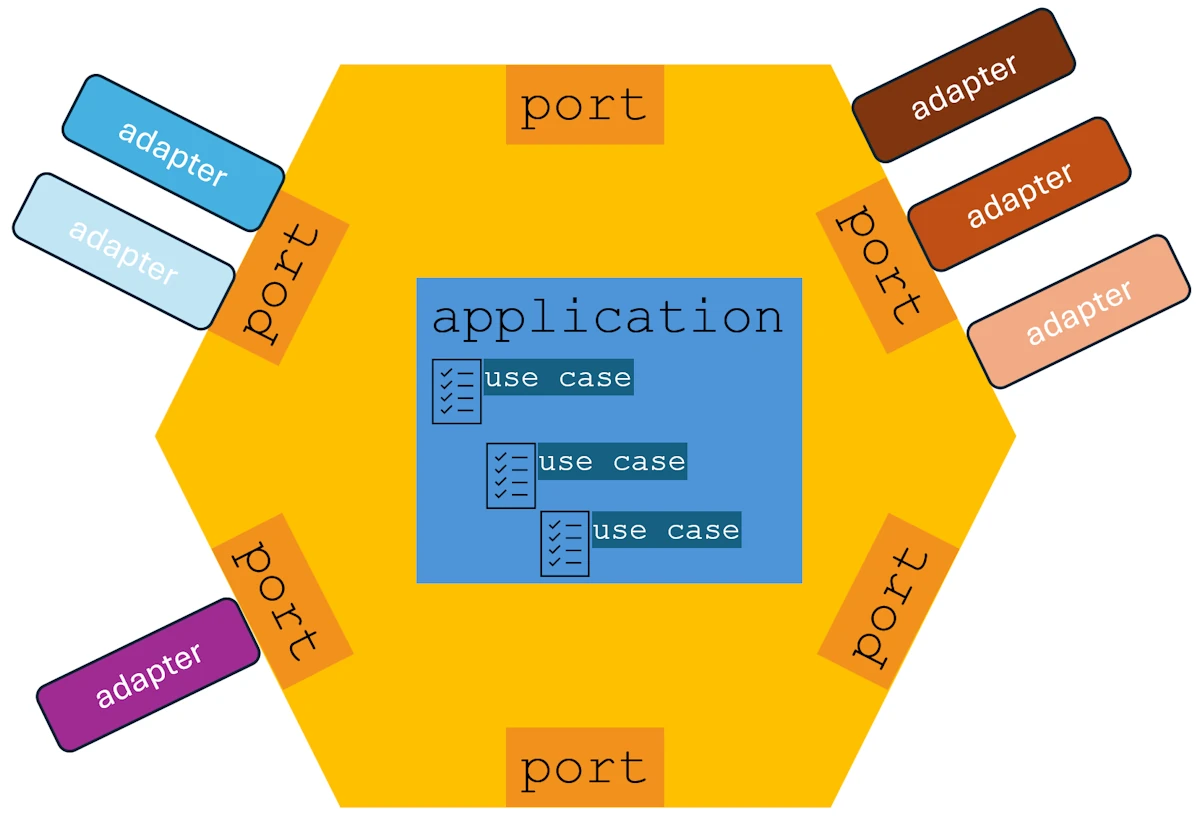
May be, one key to understand Hexagonal Architecture, as well as the behavior of the preceding sample code, is to consider the application as an orchestrator. It drives the execution of a use case by coordinating its steps, issuing requests for actions without implementing them directly. The knowledge and technical know-how needed to fulfill those requests exist outside the application boundary, which is exactly what the hexagonal model is meant to illustrate.
The distinction is not between layers or milestones, no, the distinction is between inside and outside. The hexagon provides an image with 6 ports where more than one adapter can be plugged.
Optional: ex07.rs code review
Does it works?
cargo run --example ex07
Expected output:
--- In-memory configuration ---

  [MockPayment] Charging $179.98
  [InMemory] Saving order OrderId(1)
  [Console] Order OrderId(1) confirmed, total $179.98

  Success! Order OrderId(1) placed.


--- External services configuration ---

  [Stripe] Charging $179.98
  [Postgres] INSERT order OrderId(1)
  [SendGrid] Sending confirmation for order OrderId(1)

  Success! Order OrderId(1) placed.

  [Postgres] SELECT order OrderId(1)
  Retrieved: 2 items, total $179.98
Now open examples/ex07.rs. You have all the tools to understand what is going on. Feel free to read the comments, rename variable, traits… Break everything and make it work again.
Webliography
- The original paper from 2025.
- A set of 5 blog posts about SOLID with Rust
- Full of examples
- The last one focus on the Dependency Inversion Principle
- The companion repo of this post is on GitHub
- This project demonstrates an Hexagonal Architecture where all components are in individual crates (Modular Monolith)
- (beginners) Would you like to check your knowledge with some flashcards? Works fine on cell phones. It is hosted for free on Heroku and may be slow to startup.
- Read Pragmatic programmer. It cannot hurt.
- You’re welcome to share comments or suggestions on GitHub to help improve this article.