Learning Modular Monolith Architecture with Rust
Learn Rust modular monolith: 7-step tutorial from Hello World to I/O-agnostic application with hexagonal architecture, traits and crates. For beginners, tinkerers, hobbyists, amateurs, and early-career developers…
This is Episode 05
All the examples are on GitHub
The Posts Of The Saga
- Episode 00: 🟢 Introduction + Step 00 - First prototype working
- Episode 01: 🟢 Step 01 - Split the source code in multiple files
- Episode 02: 🟢 Step 02 - Add a test folder
- Episode 03: 🟢 Step 03 - Implement Hexagonal Architecture
- Episode 04: 🔵 Step 04 - One crate per component
- Episode 05: 🔴 Step 05 - Anyhow & ThisError
- Episode 06: 🟢 Step 06 - Add new adapters + Conclusion
- Episode 07: 🟢 Bonus

Table of Contents
Objective
We want to include anyhow and thiserror crates. At the end of this episode, the folder hierarchy should look like this:
step_05
│   Cargo.toml
└───crates
    ├───adapter_console
    │   │   Cargo.toml
    │   ├───src
    │   │       errors.rs
    │   │       input.rs
    │   │       lib.rs
    │   │       output.rs
    │   └───tests
    │           adapter_console_test.rs
    ├───app
    │   │   Cargo.toml
    │   └───src
    │           main.rs
    ├───application
    │   │   Cargo.toml
    │   ├───src
    │   │       errors.rs
    │   │       greeting_service.rs
    │   │       lib.rs
    │   └───tests
    │           application_test.rs
    ├───domain
    │   │   Cargo.toml
    │   ├───src
    │   │       errors.rs
    │   │       greeting.rs
    │   │       lib.rs
    │   │       ports.rs
    │   └───tests
    │           domain_test.rs
    └───integration_tests
        │   Cargo.toml
        ├───src
        │       lib.rs
        └───tests
                integration_test.rs
Setup
- Save your work
- Quit VSCode
- You should have a terminal open and you should be in the
step_04/folder
cd ..
# make a copy the folder step_04 and name it step_05
Copy-Item ./step_04 ./step_05 -Recurse
cd step_05
code .
- If you have ANY doubt about
anyhoworthiserrorbefore you move forward, read this dedicated page.
Actions
Cargo.toml
[workspace]
members = [
    "crates/domain",
    "crates/application",
    "crates/adapter_console",
    "crates/app",
    "crates/integration_tests",
]
resolver = "3"

[workspace.package]
version = "0.1.0"
edition = "2024"
license = "MIT"

[workspace.dependencies]
thiserror = "2.0"
anyhow = "1.0"
Points of attention:
- Obviously,
thiserrorandanyhoware listed in the[workspace.dependencies]
The domain crate
Here is Cargo.toml:
[package]
name = "domain"
version.workspace = true
edition.workspace = true
license.workspace = true

[dependencies]
thiserror.workspace = true
Points of attention:
thiserroris added
Let’s first look at error.rs
use thiserror::Error;

#[derive(Error, Debug)]
pub enum DomainError {
    #[error("Name cannot be empty")]
    EmptyName,
}

pub type Result<T> = std::result::Result<T, DomainError>;
Points of attention:
- Everything here is domain specific.
- This is IMPORTANT
- With the help of
thiserror, we define a domain error enum (seeDomainError). So far it only have one variant (seeEmptyName). - The type alias
Resultis updated fromstd::result::Result<T, Error>tostd::result::Result<T, DomainError>
Now we can update ports.rs. And believe it or not, the final version of this one took me a while… Why? Simply because initially I put InfraError in error.rs. I knew it was wrong. I had a red LED blinking somewhere in my mind… But I was not brave (smart) enough to move it here. Then many things were overcomplicated in my first tentatives. Anyway, it took me a while but I learnt a lot. Ok, here is the code I have today:
use std::any::Any;

pub trait InfraError: std::error::Error + Send + Sync + 'static {
    fn as_any(&self) -> &dyn Any;
}

pub trait NameReader {
    fn read_name(&self) -> Result<String, Box<dyn InfraError>>;
}

pub trait GreetingWriter {
    fn write_greeting(&self, greeting: &str) -> Result<(), Box<dyn InfraError>>;
}
Points of attention:
Important. Look at the figure below:
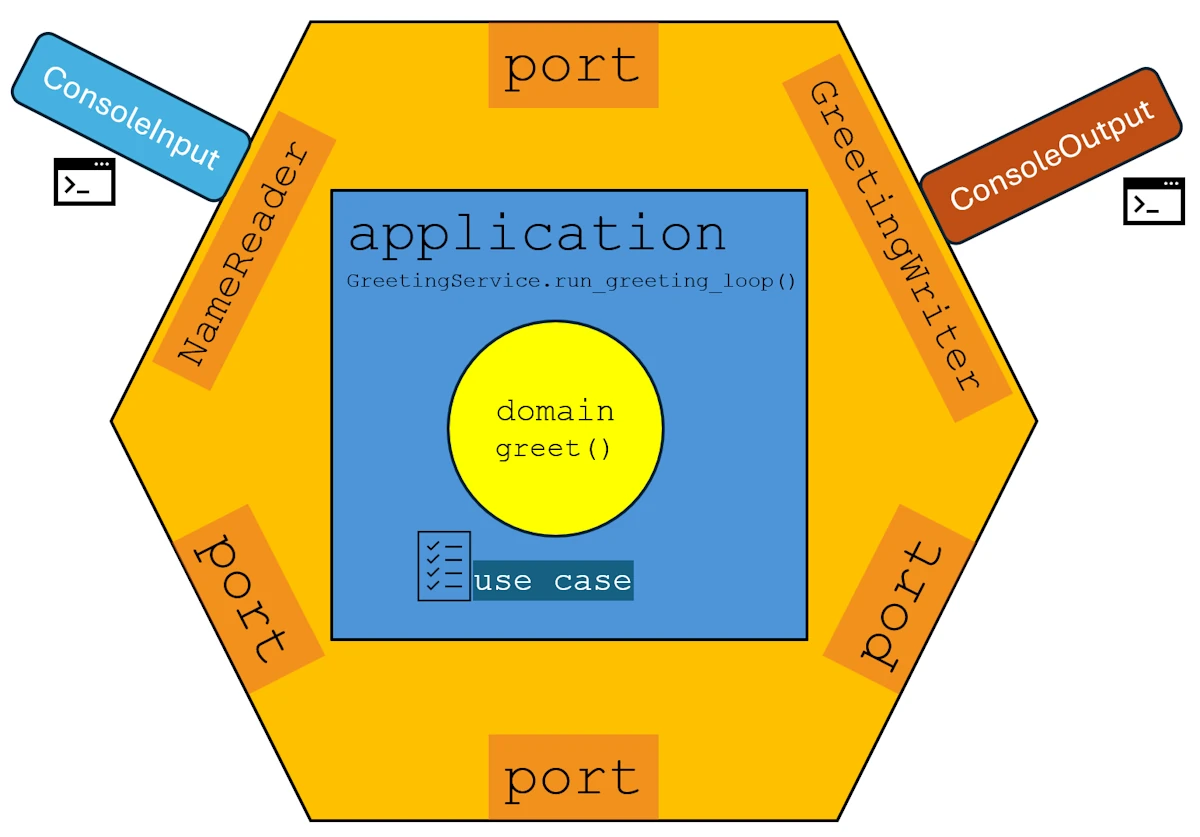
My understanding is as follow:
- when an adapter reports an error this is an error from the “outside world”, the infrastructure (file missing, network error…).
- We don’t know and we cannot know them all at compile time (today the input come from UDP, tomorrow it will come from a keyboard…).
- This is why a trait for infrastructure errors is defined (see
InfraError). In fact,InfraErroris a contract that thedomainimposes on the adapters: “if you want to report an infra error to me, implement this feature.” - Here in the code
as_any()returnsselfasAny. Later, this will allow downcasting from abstract object to concrete types. - Once
InfraErroris defined the new signature ofread_nameandwrite_greetingexplains that, on error, they will returnBox<dyn InfraError>
In greeting.rs, only the beginning of the code is updated because now, it can return a domain specific error when the name is empty:
use crate::errors::{DomainError, Result};

pub fn greet(name: &str) -> Result<String> {
    if name.is_empty() {
        return Err(DomainError::EmptyName);
    }
// Rest of the code unmodified
}
Finally here is lib.rs:
pub mod errors;
pub mod greeting;
pub mod ports;

pub use greeting::greet;
pub use ports::{GreetingWriter, InfraError, NameReader};
Points of attention:
- The reason why
GreetingWriter,InfraErrorandNameReaderare re-exported here is to “hide” the name “ports” so that in the input module of theadapter_consolecrate we will writeuse domain::{NameReader, InfraError}instead ofuse domain::{NameReader, ports::InfraError};. Yes, I know, this somewhat contradict what I said in Step 02 but we have to be pragmatic.
The adapter_console crate
[package]
name = "adapter_console"
version.workspace = true
edition.workspace = true
license.workspace = true

[dependencies]
domain = { path = "../domain" }
thiserror.workspace = true
Points of attention:
thiserroris added
The errors.rs file now looks like:
use domain::InfraError;
use std::any::Any;
use thiserror::Error;

#[derive(Error, Debug)]
pub enum ConsoleError {
    #[error("Console I/O error: {0}")]
    Io(#[from] std::io::Error),
}

impl InfraError for ConsoleError {
    fn as_any(&self) -> &dyn Any {
        self
    }
}

pub(crate) fn into_infra(e: impl Into<ConsoleError>) -> Box<dyn InfraError> {
    Box::new(e.into())
}
Points of attention:
- To make a long story short, here, every line is important but we will understand why when we will read
input.rsandoutput.rs - Using
thiserrorwe first express what is aConsoleError - Then we implement
InfraErrorforConsoleError - At the very bottom of the code there is a utility function which is used in
input.rsandoutput.rs
Here is the new version of output.rs:
use crate::errors::into_infra;
use domain::GreetingWriter;
use domain::InfraError;
use std::io::{self, Write};

#[derive(Default)]
pub struct ConsoleOutput;

impl ConsoleOutput {
    pub fn new() -> Self {
        Self
    }
}

impl GreetingWriter for ConsoleOutput {
    fn write_greeting(&self, greeting: &str) -> Result<(), Box<dyn InfraError>> {
        // println!("{greeting}"); is replaced by the next expression to show
        // how to handle error (e.g., stdout redirected to full disk)
        writeln!(io::stdout(), "{greeting}").map_err(into_infra)?;
        //                                  .map_err(|e| Box::new(ConsoleError::from(e)) as Box<dyn InfraError>)?;
        Ok(())
    }
}
Points of attention:
- Check the
use domain::InfraError; - In the signature of
write_greeting, see theResult<(), Box<dyn InfraError>> - In the implementation of
GreetingWriterforConsoleOutputI no longer useprintln!butwriteln!. Indeed the firstpanic!on error while the second return an error. - Then we take this error and we map it to an InfraError. This is the purpose of
into_infrawhich shorten the closure in comment. How does this work?- The error, if any, is a
std::io::Errorand we want to convert it into aInfraError into_infracallse.into()and this triggers the#[from]conversion- The
#[from]generatesimpl From<std::io::Error> for ConsoleError, which buildsConsoleError::Io(e) - That
ConsoleError::Io(e)gets boxed asBox<dyn InfraError> - So
ConsoleError::Iois constructed every time an I/O error occurs. We don’t see it explicitly in the code becauseinto()does the job for us.
- The error, if any, is a
Ok but why do we need ConsoleError?
pub enum ConsoleError {
    #[error("Console I/O error: {0}")]
    Io(#[from] std::io::Error),
}
Because we have
impl InfraError for ConsoleError {...}
The orphan rule says : you can only implement a trait for a type if either the trait or the type is defined in your own crate.
In our case, this can be translated into: we can’t implement InfraError for std::io::Error in the adapter crate. Indeed, we don’t own the trait (it’s in domain) nor the type (it’s in std). Finally, ConsoleError is the type that makes impl InfraError for ConsoleError legal.
I told you, in errors.rs every line is important.
In input.rs we now have:
use crate::errors::into_infra;
use domain::{InfraError, NameReader};
use std::io::{self, Write};

#[derive(Default)]
pub struct ConsoleInput;

impl ConsoleInput {
    pub fn new() -> Self {
        Self
    }
}

impl NameReader for ConsoleInput {
    fn read_name(&self) -> Result<String, Box<dyn InfraError>> {
        print!("> ");
        io::stdout().flush().map_err(into_infra)?;
        //                  .map_err(|e| Box::new(ConsoleError::from(e)) as Box<dyn InfraError>)?;

        let mut input = String::new();
        io::stdin().read_line(&mut input).map_err(into_infra)?;
        //                               .map_err(|e| Box::new(ConsoleError::from(e)) as Box<dyn InfraError>)?;

        Ok(input.trim().to_string())
    }
}
The app crate
[package]
name = "app"
version.workspace = true
edition.workspace = true
license.workspace = true

[[bin]]
name = "step_05"
path = "src/main.rs"

[dependencies]
application = { path = "../application" }
adapter_console = { path = "../adapter_console" }
anyhow.workspace = true
Points of attention:
anyhowis in the dependencies
The error.rs file has been deleted, only remains main.rs:
use adapter_console::{ConsoleInput, ConsoleOutput};
use application::GreetingService;

use anyhow::{Context, Result};

fn main() -> Result<()> {
    println!("=== Greeting Service (Step 05 - Modular Monolith & Hexagonal Architecture) ===");
    println!("Enter a name to greet (or 'quit' to exit):\n");

    // Dependency injection: Create adapters
    let input = ConsoleInput::new();
    let output = ConsoleOutput::new();

    // Create application service and run either in a loop or once
    let service = GreetingService::new();

    // service
    //     .run_greeting_loop(&input, &output)
    //     .context("Failed to run interactive loop")?;

    service
        .run_greeting_once(&input, &output)
        .context("Failed to run the greeting service once")?;

    Ok(())
}
Points of attention:
- As we will see in the application crate (in charge of orchestrating the use cases) I added a
run_greeting_once()use case. - The code above demonstrates that, no matter the use case, from
main()the calling process is the same. - If you want to test the
run_greeting_loop()again, simply uncomment/comment the concerned lines. During your tests, don’t be afraid to break everything. Make it works again will be always instructive.
The application crate
[package]
name = "application"
version.workspace = true
edition.workspace = true
license.workspace = true

[dependencies]
domain = { path = "../domain" }
thiserror.workspace = true
Points of attention:
thiserroris added
lib.rs is not impacted.
Let’s see how errors.rs works:
use domain::InfraError;
use domain::errors::DomainError;
use thiserror::Error;

#[derive(Debug, Error)]
pub enum ApplicationError {
    #[error("Domain error: {0}")]
    Domain(#[from] DomainError),

    #[error("Infrastructure error: {0}")]
    Infrastructure(Box<dyn InfraError>),
}

pub type Result<T> = std::result::Result<T, ApplicationError>;

impl From<Box<dyn InfraError>> for ApplicationError {
    fn from(e: Box<dyn InfraError>) -> Self {
        Self::Infrastructure(e)
    }
}
- Remember… A use case in the application crate can receive 2 kinds of error: the ones from the domain (
DomainError, whennameis empty) and the ones from the outside world (InfraError, after Skynet decided to shutdown all the others networks). - So an
ApplicationErroris an enum. It can either be aDomainErroror anInfraError - As usually we keep defining an alias for
Result<T> - At the very end we implement
Fromin order to convert anInfraErrorinto anApplicationError
If we focus our attention solely on the flow followed by the different types of errors, we can summarize the situation with the following mental model:
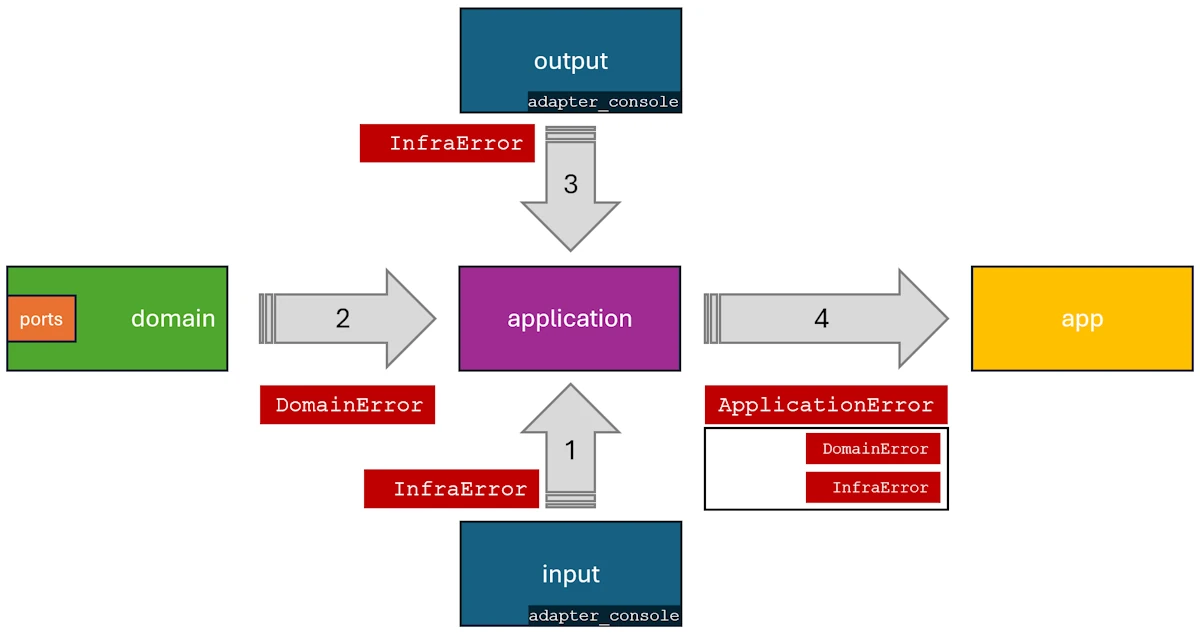
InfraError (from the adapters), arrow 2 carries DomainError (from the business logic), and arrow 4 carries ApplicationError which wraps either one.Now, let’s see how the new use case looks like in greeting_service.rs:
use crate::errors::Result;

#[derive(Default)]
pub struct GreetingService;

impl GreetingService {
    pub fn new() -> Self {
        Self
    }

    pub fn run_greeting_once(
        &self,
        input: &dyn domain::NameReader,
        output: &dyn domain::GreetingWriter,
    ) -> Result<()> {
        let name = input.read_name()?;
        let greeting = domain::greet(&name)?;
        output.write_greeting(&greeting)?;
        println!("\nGoodbye!");
        Ok(())
    }

    pub fn run_greeting_loop(
        &self,
        input: &dyn domain::NameReader,
        output: &dyn domain::GreetingWriter,
    ) -> Result<()> {
        loop {
            let name = input.read_name()?;

            if name.eq_ignore_ascii_case("quit")
                || name.eq_ignore_ascii_case("exit")
                || name.eq_ignore_ascii_case("q!")
            {
                println!("\nGoodbye!");
                break;
            }

            let greeting = match domain::greet(&name) {
                Ok(g) => g,
                Err(e) => {
                    println!("Error: {e}\n");
                    continue;
                }
            };
            output.write_greeting(&greeting)?;
            println!(); // Extra newline for readability
        }
        Ok(())
    }
}
Points of attention:
- Thanks to the
?operator at the end of each line, therun_greeting_once()use case is deceptively straightforward. However we should not forget this ease of reading come from all the conversion of error types that take place behind the scene. - Note how in order to demonstrate how errors bulbe-up, in
run_greeting_loopI removed theif name.is_empty(){...}block of code and handle the errors returned bydomain::greet()(here we just print the error and continue)
The integration_tests crate
Only one change in integration_test.rs indeed, the line:
use domain::{GreetingWriter, NameReader, error::Result};
becomes:
use domain::{GreetingWriter, InfraError, NameReader};
Then read_name and write_greeting have the signature we already explained when we talked about input and output modules of the adapter_console crate.
Build, run & test
Build, run and test the application. Try this:
cargo test -p adapter_console
cargo test -p adapter_console --test adapter_console_test
cargo test -p adapter_console --test adapter_console_test console # any test containing "console"

cargo test -p application
cargo test -p domain --test domain_test
cargo test -p integration_tests

cargo run -p app
cargo run
Build, run and test the application. Find below the expected output:
If the use case is once here is what you can see:
cargo run
    Finished `dev` profile [unoptimized + debuginfo] target(s) in 0.03s
     Running `C:/Users/phili/rust_builds/Documents/Programmation/rust/01_xp/046_modular_monolith/step_05\debug\step_05.exe`
=== Greeting Service (Step 05 - Modular Monolith & Hexagonal Architecture) ===
Enter a name to greet (or 'quit' to exit):

> World
Hello World.

Goodbye!
Below is the output with the loop use case:
cargo run
   Compiling app v0.1.0 (C:\Users\phili\OneDrive\Documents\Programmation\rust\01_xp\046_modular_monolith\step_05\crates\app)
    Finished `dev` profile [unoptimized + debuginfo] target(s) in 0.42s
     Running `C:/Users/phili/rust_builds/Documents/Programmation/rust/01_xp/046_modular_monolith/step_05\debug\step_05.exe`
=== Greeting Service (Step 05 - Modular Monolith & Hexagonal Architecture) ===
Enter a name to greet (or 'quit' to exit):

> Marcel
Hello Marcel.
>
Error: Name cannot be empty

> q!

Goodbye!
And now the test:
 cargo test -p domain
    Finished `test` profile [unoptimized + debuginfo] target(s) in 0.02s
     Running unittests src\lib.rs (C:/Users/phili/rust_builds/Documents/Programmation/rust/01_xp/046_modular_monolith/step_05\debug\deps\domain-812d4dc27a84c7ce.exe)

running 0 tests

test result: ok. 0 passed; 0 failed; 0 ignored; 0 measured; 0 filtered out; finished in 0.00s

     Running tests\domain_test.rs (C:/Users/phili/rust_builds/Documents/Programmation/rust/01_xp/046_modular_monolith/step_05\debug\deps\domain_test-11a40ea11f17113d.exe)

running 9 tests
test domain_should_handle_unicode_names ... ok
test domain_should_truncate_long_unicode_names ... ok
test empty_name_returns_error ... ok
test boundary_case_nineteen_chars ... ok
test greeting_length_limit ... ok
test domain_should_not_use_special_greeting_for_similar_names ... ok
test roberto_special_case ... ok
test normal_greeting ... ok
test truncation_for_long_names ... ok

test result: ok. 9 passed; 0 failed; 0 ignored; 0 measured; 0 filtered out; finished in 0.00s

   Doc-tests domain

running 0 tests

test result: ok. 0 passed; 0 failed; 0 ignored; 0 measured; 0 filtered out; finished in 0.00s
Summary
What have we done so far?
anyhowandthiserrorare now integrated.- We added a use case (
.run_greeting_once())- The need to return specific errors forced us to distinguish between
InfraErrorandDomainErrorand to find a way to return either one within a single container (ApplicationError).- It was an opportunity to impose an additional port (
InfraError) to the adapters if they want to report errors from the infrastructure.- Implementing the
Fromtrait forInfraErrorhelped to keep the?in the source code.
Next Steps
Next you can read Episode 06 but I would recommend to take a break or sleep on it. Tomorrow will be another day…
- Episode 00: Introduction + Step 00 - First prototype working
- Episode 01: Step 01 - Split the source code in multiple files
- Episode 02: Step 02 - Add a test folder
- Episode 03: Step 03 - Implement Hexagonal Architecture
- Episode 04: Step 04 - One crate per component
- Episode 05: Step 05 - Anyhow & ThisError
- Episode 06: Step 06 - Add new adapters + Conclusion
- Episode 07: Bonus