Function, Method, Closure, Coroutine and Iterator in Rust
A short, practical reminder with working examples.
TL;DR
- For beginners, tinkerers, hobbyists, amateurs, and early-career developers…
- Function: Executes once, returns once
- Method: Function tied to a type
- Closure: Function that captures environment variables
- Coroutine: Function that can suspend and resume, maintaining state across suspension points
- Iterator: Produces a sequence of values lazily, one at a time
Note The companion project with all the examples is available on GitHub.

1992: When Batman returned and Windows 3.1 relied on cooperative multitasking via coroutines.
Table of Contents
- Function
- Function Pointer
- Method
- Associated Function (“Static” Method)
- Closure
- Coroutine
- Iterator
- Are iterators based on coroutines?
Function
- Runs from start to finish in one go
- Returns a single value
- Stack is destroyed when it returns
- No state preservation between calls
Example: You can copy and paste the code below into the Rust Playground:
// cargo run --example ex00
// Function

fn regular_function(x: i32) -> i32 {
    println!("Regular function computing {} * 2", x);
    x * 2
}

fn main() {
    let result = regular_function(5);
    println!("Result: {}\n", result);
}
Expected output:
Regular function: computing 5 * 2
Result: 10
Function Pointer
- A primitive type (
fn) that points to the address of a function - Does not capture any environment variables (unlike closures, see below)
- Has a fixed size (the size of a pointer)
- Can be passed to other functions as arguments or stored in data structures
- Functions that don’t capture anything can be coerced to function pointers
Example: You can copy and paste the code below into the Rust Playground:
// cargo run --example ex_01
// Function Pointer

fn add_one(x: i32) -> i32 {
    x + 1
}

fn do_math(f: fn(i32) -> i32, arg: i32) -> i32 {
    f(arg)
}

fn main() {
    // Passing a named function as a pointer
    let result = do_math(add_one, 5);
    println!("Named function result: {}", result);

    // Closures that don't capture state can also be function pointers
    let closure_ptr: fn(i32) -> i32 = |x| x * 2;
    let result_closure = do_math(closure_ptr, 10);
    println!("Closure pointer result: {}\n", result_closure);
}
Expected output:
Named function result: 6
Closure pointer result: 20
Method
- A function associated with a type/object
- Same execution model as functions (runs to completion)
- Can access
selfdata - Methods take
selfas their first parameter, whereas Associated Functions (see below) do not
Example: You can copy and paste the code below into the Rust Playground:
// cargo run --example ex02
// Method

struct Calculator {
    multiplier: i32,
}

impl Calculator {
    fn multiply_method(&self, x: i32) -> i32 {
        println!("Method computing {} * {}", x, self.multiplier);
        x * self.multiplier
    }
}

fn main() {
    let calc = Calculator { multiplier: 3 };
    let result = calc.multiply_method(7);
    println!("Result: {}\n", result);
}
Expected output:
Method computing 7 * 3
Result: 21
Associated Function (“Static” Method)
- A function defined inside an
implblock that does not take aselfparameter - Called using the
Type::function()syntax (namespace syntax) - Often used for constructors (like
new()) or factory methods - Similar to “static methods” in other programming languages
Example: You can copy and paste the code below into the Rust Playground:
// cargo run --example ex03
// Associated Function

struct User {
    username: String,
    active: bool,
}

impl User {
    // This is an associated function (no self)
    fn new(name: &str) -> Self {
        println!("Associated Function: Creating a new User instance for {}", name);
        Self {
            username: name.to_string(),
            active: true,
        }
    }
}

fn main() {
    // We call associated functions using the :: operator
    let user = User::new("Alice");
    println!("User name: {}\n", user.username);
}
Expected output:
Associated Function: Creating a new User instance for Alice
User name: Alice
Closure
- A function that captures variables from its environment (current block)
- Still runs to completion like a regular function
- The captured state exists across multiple calls to the closure
Example 1: You can copy and paste the code below into the Rust Playground:
// cargo run --example ex04
// Closure

fn demonstrate_closure() {
    let captured_value = 10;

    let closure = |x: i32| {
        println!("Closure computing {} + captured {}", x, captured_value);
        x + captured_value
    };

    println!("Closure result: {}", closure(5));
}

fn main() {
    demonstrate_closure();
}
Expected output:
Closure computing 5 + captured 10
Closure result: 15
Example 2: You can copy and paste the code below into the Rust Playground:
// cargo run --example ex05
// Closure

pub fn shift_all<F>(data: &mut [i32], mut mutator: F)
where
    F: FnMut(i32) -> i32,
{
    for v in data {
        *v = mutator(*v);
    }
}

fn main() {
    let bias = 42;
    let add_bias = |n| n + bias;

    let mut my_data = vec![1, 3, 5, 7];
    shift_all(&mut my_data, add_bias);

    println!("{:?}", my_data);
}
Expected output:
[43, 45, 47, 49]
Note
- Rust has three traits for closures:
Fn(reads),FnMut(modifies), andFnOnce(consumes). - Rust chooses the most restrictive one automatically based on what you do inside the
|| {}. - Read this page
Example 3: You can copy and paste the code below into the Rust Playground:
// cargo run --example ex06
// Generator-style coroutine (using iterator)

fn generator_style(start: i32, count: i32) -> impl Iterator<Item = i32> {
    (0..count).map(move |i| {
        println!("Generator: yielding value {}", start + i);
        start + i
    })
}

fn main() {
    let mut iterator = generator_style(100, 3);
    println!("First value: {:?}", iterator.next());
    println!("Second value: {:?}", iterator.next());
    println!("Third value: {:?}", iterator.next());
}
Note:
move |i|?(0..count)create aRange<i32>which goes from 0 tocount-1..map(move |i| { ... })transforms each element of the range (igoes from 0 to 3)moveforce the closure to take the ownership of the variables it captures (otherwise it get the variables by reference and it does not compile. Make a test, remove themove)- If
moveis removed the explanation goes like that: The closure attempts to capturestartby reference (&start), butstartlives in the stack ofgenerator_style(). When the function returns,startis destroyed, and the closure would contain an invalid reference (dangling reference). Not a good idea, especially for the next time closure will execute.
- If
moveforces the closure to copystart(becausei32implementsCopy). The closure now has its own copy ofstart, independent of thegenerator_style()function and everybody is happy-happy.
Expected output:
Generator: yielding value 100
First value: Some(100)
Generator: yielding value 101
Second value: Some(101)
Generator: yielding value 102
Third value: Some(102)
Note: In Rust, the distinction between a Closure and a Function Pointer is purely about state. If we need to pass “logic” to a function without needing any external variables, a function pointer is the most efficient way to do it.
Coroutine
- Can pause and resume execution
- Maintains its execution state (local variables, instruction pointer)
- Can yield multiple values over time
- Often used for async operations, generators, or cooperative multitasking
- Primarily implemented through
async/await, which compile to state machines that can be suspended at.awaitpoints.
Example: You can copy and paste the code below into the Rust Playground:
// cargo run --example ex07
// async with tokio & reqwest

use std::time::Instant;

#[tokio::main]
async fn main() {
    // Sequential requests
    println!("Sequential requests:");
    let start_sequential = Instant::now();
    fetch_sequential().await;
    let duration_sequential = start_sequential.elapsed();
    println!("Total sequential time: {:?}\n", duration_sequential);

    // Async requests
    println!("Async requests:");
    let start_async = Instant::now();
    asynchronously().await;
    let duration_async = start_async.elapsed();
    println!("Total async time: {:?}\n", duration_async);
}

async fn fetch_sequential() {
    let urls = vec!["https://www.google.com", "https://www.microsoft.com"];

    for url in urls {
        let start = Instant::now();
        match fetch_url(url).await {
            Ok(_) => {
                let duration = start.elapsed();
                println!("  {} - {:?}", url, duration);
            }
            Err(e) => {
                println!("  {} - Error: {}", url, e);
            }
        }
    }
}

async fn asynchronously() {
    let urls = vec!["https://www.google.com", "https://www.microsoft.com"];

    // Create a vector of futures
    let mut tasks = vec![];

    for url in urls {
        let url = url.to_string();
        let task = tokio::spawn(async move {
            let start = Instant::now();
            let result = fetch_url(&url).await;
            let duration = start.elapsed();
            (url, result, duration)
        });
        tasks.push(task);
    }

    // Wait for all tasks to complete
    for task in tasks {
        match task.await {
            Ok((url, result, duration)) => match result {
                Ok(_) => println!("  {} - {:?}", url, duration),
                Err(e) => println!("  {} - Error: {}", url, e),
            },
            Err(e) => println!("  Task error: {}", e),
        }
    }
}

async fn fetch_url(url: &str) -> Result<(), reqwest::Error> {
    let _response = reqwest::get(url).await?;
    Ok(())
}
Expected output:
Sequential requests:
  https://www.google.com - 147.6548ms
  https://www.microsoft.com - 125.9957ms
Total sequential time: 274.657ms

Async requests:
  https://www.google.com - 72.3342ms
  https://www.microsoft.com - 116.1267ms
Total async time: 116.6558ms
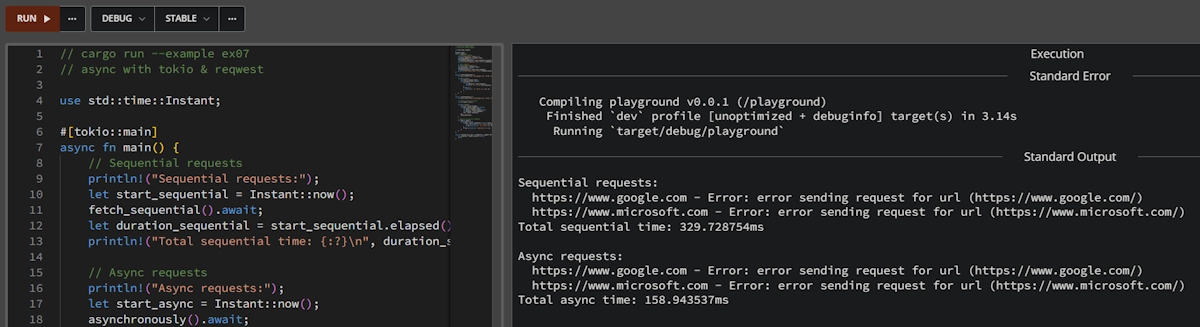
Note At the time of writing, the code above runs in Rust Playground but I get the following error messages. Surprisingly the timing are in the correct order of magnitude (300 vs 150, see below).
Sequential requests:
  https://www.google.com - Error: error sending request for url (https://www.google.com/)
  https://www.microsoft.com - Error: error sending request for url (https://www.microsoft.com/)
Total sequential time: 329.728754ms

Async requests:
  https://www.google.com - Error: error sending request for url (https://www.google.com/)
  https://www.microsoft.com - Error: error sending request for url (https://www.microsoft.com/)
Total async time: 158.943537ms
Note Here is the [dependencies] section of the Cargo.toml file of the companion project I use locally.
[dependencies]
reqwest = "0.13.1"
tokio = { version = "1.49.0", features = ["macros", "rt-multi-thread"] }
Note
- Don’t trust the comment under the first picture above, check by yourself and read the article Windows Multitasking: A Historical Aside
- You can also read: How was Multi-Tasking Possible in Older Versions of Windows?
Iterator
- Represents a sequence of values produced one at a time
- Maintains internal iteration state between calls
- Returns the next value on each call, or signals completion
- Often used in for / foreach loops
- Does not necessarily store all values in memory
- Can be implemented by collections, generators, or custom types
- May be finite or infinite
Example: You can copy and paste the code below into the Rust Playground:
// cargo run --example ex08
// Iterator
struct Counter {
    current: u64,
}

impl Iterator for Counter {
    type Item = u64;

    fn next(&mut self) -> Option<Self::Item> {
        let value = self.current;
        self.current += 1;
        Some(value) // Never returns None → infinite iterator
    }
}

fn main() {
    let counter = Counter { current: 0 };

    for n in counter.take(5) {
        println!("{}", n);
    }
}
Expected output:
0
1
2
3
4
Are iterators based on coroutines?
No, an iterator is not a coroutine in the traditional sense.
Iterator can behaves like a coroutine but but:
- Iterators simulate this through state stored in struct fields
- Coroutines achieve this through actual execution suspension
Iterator
- Pull-based: The consumer calls
.next()to get values - Synchronous: Computation happens immediately when
.next()is called - State machine: Implemented as a struct with state fields
- No suspension points: Code doesn’t “pause” - each
.next()runs fresh logic - Simple trait: Just needs
fn next(&mut self) -> Option<Item>
Coroutine (async/await)
- Push-based: (in async context): The runtime drives execution
- Asynchronous: Can wait for I/O, timers, etc.
- State machine: Compiler generates one from async fn
- Suspension points: Can
.awaitand resume later - Complex: Involves
Future,Poll,Waker, executors
Philosophical Difference
A mind model for Iterator
Each call is a fresh execution of the
next()method. There’s no “pausing” mid-function.
User calls next() → Execute logic → Return value → DONE
User calls next() → Execute logic → Return value → DONE
User calls next() → Execute logic → Return value → DONE
A mind model for Coroutine
A single execution that suspends and resumes, preserving the exact position and local variables.
Start execution → Compute → PAUSE (await)
                           ↓
Resume → Compute more → PAUSE (await)
                           ↓
Resume → Compute more → DONE (return)
Visual Comparison
// Iterator: each next() call executes independently
struct Counter { count: i32, max: i32 }

impl Iterator for Counter {
    type Item = i32;

    fn next(&mut self) -> Option<i32> {
        // This code runs fresh each time
        // No "pausing" - just checking state and updating
        if self.count < self.max {
            self.count += 1;
            Some(self.count)
        } else {
            None
        }
    }
}

// Coroutine: execution can suspend and resume
async fn async_counter(max: i32) -> Vec<i32> {
    let mut results = vec![];
    for i in 0..max {
        // This is a suspension point - execution can pause here
        some_async_operation().await;
        results.push(i);
    }
    results
}
Example: You can copy and paste the code below into the Rust Playground:
// cargo run --example ex09
// Iterator vs coroutine

use tokio::time::{Duration, sleep};

// Iterator: each next() call executes independently
struct Counter {
    count: i32,
    max: i32,
}

impl Iterator for Counter {
    type Item = i32;

    fn next(&mut self) -> Option<i32> {
        // This code runs fresh on every call to next()
        // No suspension, just state checking and updating
        if self.count < self.max {
            self.count += 1;
            Some(self.count)
        } else {
            None
        }
    }
}

// Simulated async operation
async fn some_async_operation() {
    // Simulate an async I/O or timer-based operation
    sleep(Duration::from_millis(200)).await;
}

// Coroutine: execution can suspend and resume
async fn async_counter(max: i32) -> Vec<i32> {
    let mut results = vec![];

    for i in 0..max {
        // Suspension point: the task can pause here
        some_async_operation().await;
        results.push(i);
    }

    results
}

#[tokio::main]
async fn main() {
    // --- Iterator demo ---
    let counter = Counter { count: 0, max: 3 };

    println!("Iterator output:");
    for value in counter {
        println!("  {}", value);
    }

    // --- Async coroutine demo ---
    println!("\nAsync coroutine output:");
    let values = async_counter(3).await;

    for value in values {
        println!("  {}", value);
    }
}
Expected output:
Iterator output:
  1
  2
  3

Async coroutine output:
  0
  1
  2
Note
- Is it crystal clear why both outputs are different? Do you feel brave enough to play with the code in Rust Playground so that they become similar?
- I find that this difference is interesting from the learning standpoint:
- The iterator encodes its logic in the
next(). - The async coroutine encodes its logic in the code structure (
for,.await). - Same intent, but the “where” of the control is different.
- The iterator encodes its logic in the